Researchers pioneer method to rapidly design proteins
Their strategy revealed new details that open the door to designing proteins with powerful abilities that could ultimately benefit medicine and manufacturing.
By Carol Tseng
Key takeaways:
- Researchers developed a new way to design proteins.
- With the help of SLAC's synchrotron light source, the team uncovered details about a well-known designed protein, then redesigned it to create two new proteins that performed beyond expectations.
- This method offers a potentially simpler pathway to making improved drugs and catalysts.
Researchers use synchrotron X-rays to identify promising candidate in the battle against antibiotic resistance
Studies reveal new molecular structure details that open a pathway in the drug delivery process.

Using bright X-rays from the Department of Energy’s SLAC National Accelerator Laboratory and Lawrence Berkeley National Laboratory (Berkeley Lab), researchers pioneered an innovative approach to designing proteins with targeted functions. Their method generated new insights that allowed the team to turn a single designed protein into two new proteins with completely different functions – one of which is the most active designed enzyme to date.
In the study, published in Nature Chemistry, the University of California, San Francisco (UCSF), team for the first time combined X-ray studies of how small molecule fragments bind to designed proteins, known as crystallographic fragment screening, with a method used to design proteins, called directed evolution. This breakthrough approach could lead to simpler ways to improve enzymes and medications, among other uses.
“Our novel protein design strategy simultaneously explores the landscapes of chemical space and sequence space, which helps design functional proteins rapidly,” said Sagar Bhattacharya, postdoctoral researcher at UCSF and an author on the paper. “Instead of the typical 5-10 rounds or more of directed evolution, we achieved the 10-fold higher enzyme activity with just two rounds of directed evolution.”
Synchrotron explainer
Harnessing nature’s dynamos
For decades, researchers have been using directed evolution to design proteins to specialize in one function, such as an enzyme that catalyzes a chemical reaction. Creating new proteins from scratch, a technique called de novo protein design, researchers can evolve these proteins by running computer simulations, testing its abilities, redesigning its structure based on the results and iterating this process until it has the desired functionality.
But, they have wondered if these designed proteins behave like natural proteins. Can specialist proteins weakly bind to other types of molecules – a property called “promiscuity”? And most importantly, could they be used as starting points for entirely different specialties?
To answer these fundamental questions, the UCSF team, led by Professors James Fraser and William DeGrado, realized they needed a fresh design approach. Directed evolution gave them a protein to start with. But, with endless possible molecules that could bind to that protein, they also needed a way to efficiently search for candidate small molecule fragments that could bind to the target protein and then evaluate which were successful.
The researchers matched fragment screening with X-ray crystallography at the national laboratories’ light sources. Used extensively in drug discovery, the technique reveals which small molecular fragments bind to a target protein and where they bind. Although long used for natural proteins, crystallographic fragment screening had not been used for designed proteins, until now.
Screening candidates with powerful X-rays
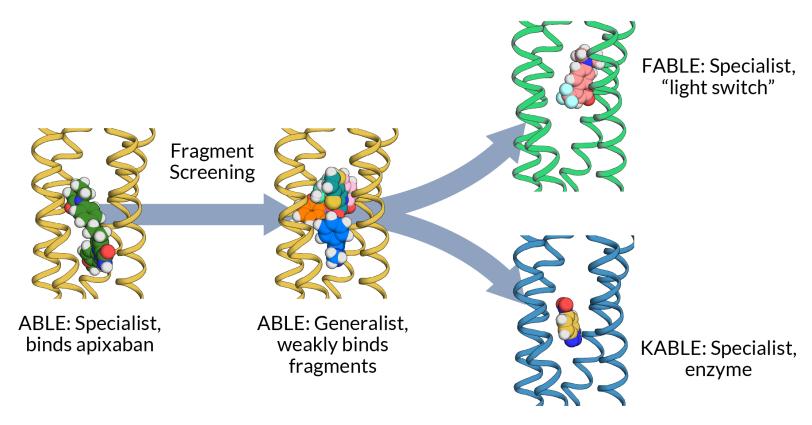
The team started with a known specialist protein that binds to the “blood thinning” drug apixaban, called apixaban-binding helical bundle (ABLE).
After selecting 320 candidate fragments, they created sample crystals by soaking the fragments with ABLE. Next, they screened the crystals at SLAC’s Stanford Synchrotron Radiation Lightsource (SSRL) and Berkeley Lab’s Advanced Light Source (ALS), hoping for a few successful hits. Instead, a surprising 43 fragments weakly bound to ABLE, with 39 binding in the same site as apixaban, demonstrating that ABLE behaved similarly to natural proteins.
From there, the team redesigned the protein, through directed evolution and computer modeling that incorporated AI models, to bind with fragments that turned ABLE into two new proteins: an enzyme (KABLE, Kemp eliminase ABLE) and a compound that “lights up” (fluorescent ABLE), which could be used as a biosensor. The team had successfully manipulated ABLE’s “promiscuity” to specialize in two new functions.
Further, testing showed that KABLE was a record-breaking 10 times more active than any of the other designed enzymes.
Another unexpected result was how the simple shape of ABLE could evolve into a powerful enzyme. “Normally, enzymes have very complicated shapes, or folds,” said Fraser. “The ABLE design is a helix, the simplest possible protein design. The fact that we were able to imbue this simple shape with this catalytic power is very surprising, considering that nature has gone to great lengths to evolve more elaborate folds and architectures to be able to catalyze reactions.”
“Researchers struggle with protein design to make very active enzymes,” noted Fraser. “But here, we took this very simple approach, and through directed evolution, we improved an enzyme to make it even more active.”
Researchers said the success of KABLE opens the door to, for example, designing less toxic enzymes for catalyzing reactions or synthesizing complex molecules for pharmaceuticals.
“This work beautifully combines high‑resolution structural data from the synchrotron with powerful AI models to reveal how weak fragment interactions can be evolved into efficient new functions,” said Aina Cohen, division director of Structural Molecular Biology at the SSRL. “This innovative strategy could unlock major breakthroughs in designing tailored enzymes for applications in medicine, chemistry and manufacturing.”
Additional contributors to this work include Vlaams Instituut voor Biotechnologie, Vrije Universiteit Brussel, Baylor University, Dana-Farber Cancer Institute and Harvard Medical School.
This research at UCSF was supported by the National Institutes of Health (NIH) and National Science Foundation (NSF). Use of the Stanford Synchrotron Radiation Lightsource, SLAC National Accelerator Laboratory, is supported by the U.S. Department of Energy, Office of Science, Office of Basic Energy Sciences. The SSRL Structural Molecular Biology Program is supported by the DOE Office of Biological and Environmental Research, and by the National Institutes of Health, National Institute of General Medical Sciences. Use of ALS is supported in part by the NIH National Institute of General Medical Sciences.
SSRL and ALS are DOE Office of Science user facilities.
Citation: Y. Chen et al., Nature Chemistry, 04 May 2026 (https://doi.org/10.1038/s41557-026-02125-6)
For media inquiries, please contact media@slac.stanford.edu. For other questions or comments, contact SLAC Strategic Communications & External Affairs at communications@slac.stanford.edu.
About SLAC
SLAC National Accelerator Laboratory explores how the universe works at the biggest, smallest and fastest scales and invents powerful tools used by researchers around the globe. As world leaders in ultrafast science and bold explorers of the physics of the universe, we forge new ground in understanding our origins and building a healthier and more sustainable future. Our discovery and innovation help develop new materials and chemical processes and open unprecedented views of the cosmos and life’s most delicate machinery. Building on more than 60 years of visionary research, we help shape the future by advancing areas such as quantum technology, scientific computing and the development of next-generation accelerators.
SLAC is operated by Stanford University for the U.S. Department of Energy’s Office of Science. The Office of Science is the single largest supporter of basic research in the physical sciences in the United States and is working to address some of the most pressing challenges of our time.